Surprising manners
Common misconceptions, and customs that differ by region or place.

Dining
What do you think?
Can you eat sushi with your hands?
Actually…
OKYes. Nigiri sushi can be eaten with your fingers or with chopsticks; both are normal.
Nigiri sushi is said to have started as quick street-stall food, which is also why each piece is bite-sized.
Read the article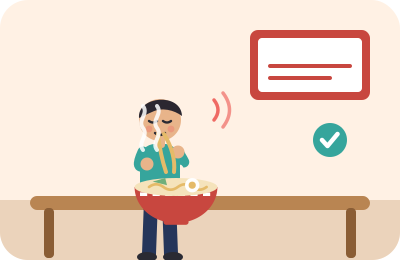
Dining
What do you think?
Is it OK to slurp ramen?
Actually…
OKSlurping noodles is generally accepted, but you do not have to slurp. Eating quietly is fine too.
Slurping is said to cool hot noodles with air and bring out the aroma, which is one reason it has long been accepted with noodle dishes.
Read the article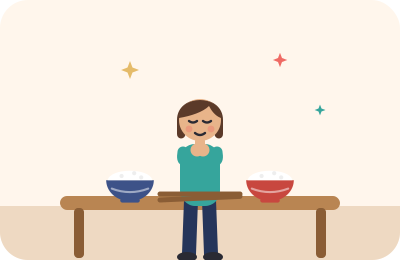
Dining
What do you think?
Do you always have to say "itadakimasu"?
Actually…
Good to know"Itadakimasu" before eating and "gochisosama" afterwards are widespread customs, not laws or rules. Saying them is a nice way to show appreciation.
It is usually explained as thanks to the life of the food, to the people who cooked it and to those who produced the ingredients. It is used apart from any specific religious prayer.
Read the article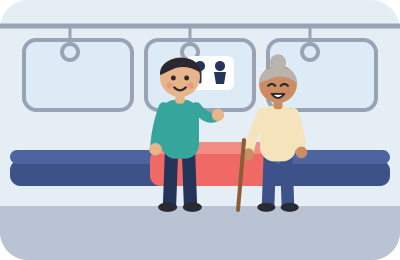
Transportation
What do you think?
Who can use priority seats?
Actually…
It dependsPriority seats are for older people, people with disabilities, pregnant people, those with small children and others who need them. Give them up when someone needs one.
Not every need is visible. Japan has a "maternity mark" worn by people in early pregnancy and a red "help mark" showing that the wearer may need support.
Read the article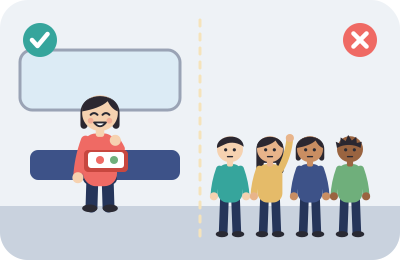
Transportation
What do you think?
Can you eat on trains in Japan?
Actually…
It dependsEating ekiben (station bento) is common on the Shinkansen and limited express trains. On commuter, local and subway trains, people generally avoid eating.
On short-distance trains many people stand, and smells or spilled food easily bother others. On long-distance trains, eating an ekiben is part of the pleasure of the journey.
Read the article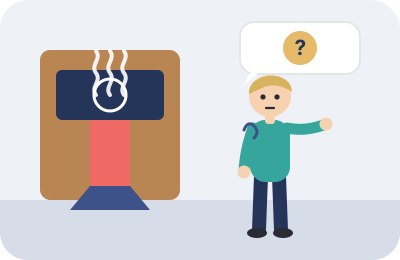
Onsen & Bathing
What do you think?
Can you enter an onsen with tattoos?
Actually…
It dependsIt depends on the facility. Some turn tattooed guests away and some welcome them, so check in advance.
Some people in Japan associate tattoos with particular images, so facilities have set their own rules. In 2016 the Japan Tourism Agency shared example responses with bathing facilities for tattooed foreign visitors, such as covering with a patch or offering private baths.
Read the article
Onsen & Bathing
What do you think?
Do you wear a swimsuit in an onsen?
Actually…
It dependsAt typical onsen and public baths you bathe naked, without a swimsuit. Some facilities, however, require a swimsuit or a special bathing garment.
Japanese bathing culture is based on washing first and then soaking without clothes. There is also the idea of keeping fibres and dirt from swimwear out of the water.
Read the article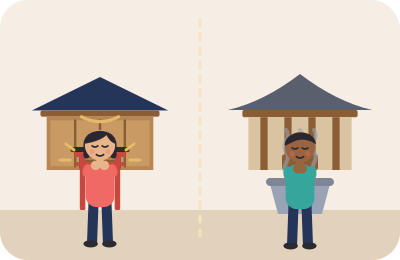
Shrines & Temples
What do you think?
Do you pray the same way at shrines and temples?
Actually…
Good to knowNo. At shrines the basic form is two bows, two claps and one bow; at temples you put your hands together quietly without clapping.
Shinto and Buddhism have different ways of praying. The clap (kashiwade) at a shrine is described as a sign of respect to the deity, while at temples people pray with palms pressed together (gassho).
Read the article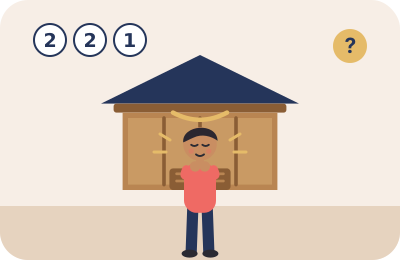
Shrines & Temples
What do you think?
Is "two bows, two claps, one bow" the same everywhere?
Actually…
It depends"Two bows, two claps, one bow" is the basic form at many shrines, but some shrines have their own style. At Buddhist temples, people do not clap.
Ways of worship have changed over a long history. Regional and shrine-specific traditions are still valued, so not every shrine uses the same form.
Read the article
Shrines & Temples
What do you think?
Is there a set amount for a shrine offering?
Actually…
Good to knowThere is no set amount for an offering (osaisen). Any amount is fine; it is given as a gesture of your feelings.
An offering expresses gratitude and prayer to the deities or buddhas. The amount does not decide whether a wish comes true.
Read the article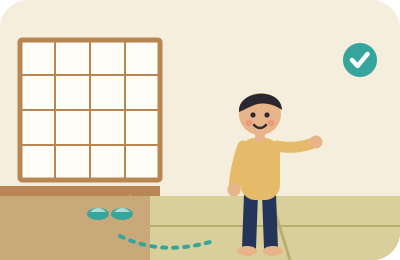
Home & Visiting
What do you think?
Can you wear slippers on tatami?
Actually…
Better notTake off your slippers before entering a tatami room. Walk on tatami in socks or bare feet.
Tatami is a delicate rush-grass floor where people sit and lie down. Slippers wear it out and bring in dirt, so the custom is to walk on it with your feet.
Read the article
Home & Visiting
What do you think?
Can you keep wearing the toilet slippers?
Actually…
Better notToilet slippers are only for inside the toilet. Take them off when you leave and switch back to your own slippers.
It keeps the toilet separate from the rest of the house for hygiene. Many people notice if someone walks into a corridor or room in the toilet slippers.
Read the article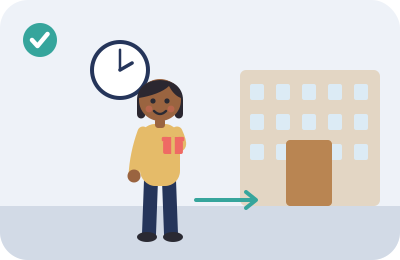
Home & Visiting
What do you think?
Is it OK to arrive early when visiting someone’s home?
Actually…
Good to knowPunctuality is valued, but when visiting a home many people avoid arriving too early and aim to arrive around the agreed time.
Keeping to the agreed time is seen as respecting the other person’s time. With home visits, consideration for the host’s preparations is added.
Read the article
Greetings
What do you think?
Do people bow in Japan?
Actually…
Good to knowYes, when greeting or thanking someone. For visitors, a light nod or slight bow (eshaku) is almost always enough.
Bowing is a Japanese way of showing respect and gratitude with the body. Its depth and length can express how strong the feeling is, but not knowing the finer rules is not rude.
Read the article
Greetings
What do you think?
Is "sumimasen" only for apologising?
Actually…
Good to knowNo. "Sumimasen" is also used to get someone’s attention, to ask people to let you pass and to say thank you.
"Sumimasen" carries a feeling of "I am sorry to trouble you". That is why it came to be used both for apologies and for thanks.
Read the article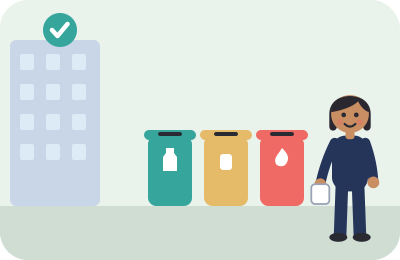
Public Spaces
What do you think?
What do you do when there are few trash bins?
Actually…
Good to knowPublic bins are scarce in Japan, so carry your trash with you and throw it away when you find a suitable bin, or take it back to where you are staying.
Bins have been reduced for various reasons, including security and maintenance. In their place, the idea of taking your own trash home is widely shared.
Read the article
Public Spaces
What do you think?
Is it OK to eat while walking?
Actually…
It dependsIt is not banned nationwide by law, but in crowded places people are expected to stop and eat, out of consideration for others. Some tourist areas ask visitors to refrain.
Eating on the move in busy places can easily stain other people’s clothes and leave crumbs or litter behind.
Read the article
Shops & Hotels
What do you think?
Do you tip in Japan?
Actually…
Good to knowTipping is generally not customary in Japan at restaurants, in taxis, at hotels and so on. A word of thanks is enough.
In Japan the price is generally understood to include the service. Some restaurants also add a service charge or a table charge (otoshi) to the bill from the start.
Read the article
Shops & Hotels
What do you think?
Do you have to use the cash tray?
Actually…
Good to knowIf there is a tray at the register, people usually put their money on it. It is not a rule, though, and staff sometimes take money by hand.
It is said to make the exchange clear so that both staff and customer can easily check the amount. It also means hands do not have to touch.
Read the article
Ceremonies
What do you think?
How do you give gift money at celebrations?
Actually…
Good to knowNever hand over bare cash: put it in a special gift envelope and offer it with both hands. For weddings, new banknotes are usually used.
New notes are said to show you prepared especially for the day. For funerals it is the opposite: new notes might suggest the death was expected.
Read the article
Ceremonies
What do you think?
Is the incense offering done the same way by everyone?
Actually…
It dependsHow many times you offer incense and the exact steps differ by Buddhist school. If unsure, simply follow the person ahead of you, the priest or the chief mourner.
Offering incense (oshoko) is a Buddhist rite to purify the heart and the space with fragrance and to honour the deceased. Each school has handed down its own way.
Read the article
Traditions & Events
What do you think?
What are the customs of Obon?
Actually…
Good to knowObon is an event to welcome ancestors’ spirits home and honour them. Most areas observe it in mid-August, some in mid-July.
It is a traditional event based on the belief that ancestors’ spirits return home, said to combine a Buddhist observance with older folk beliefs. Bon odori dances are also thought to have begun as dances to comfort the spirits.
Read the article